What is Generative Engine Optimization (GEO)?
GEO is the practice of optimizing for answers in ChatGPT, Gemini, Claude, and Perplexity. It overlaps almost entirely with AEO in execution. Here is the definitional map, the engines it targets, and the playbook.
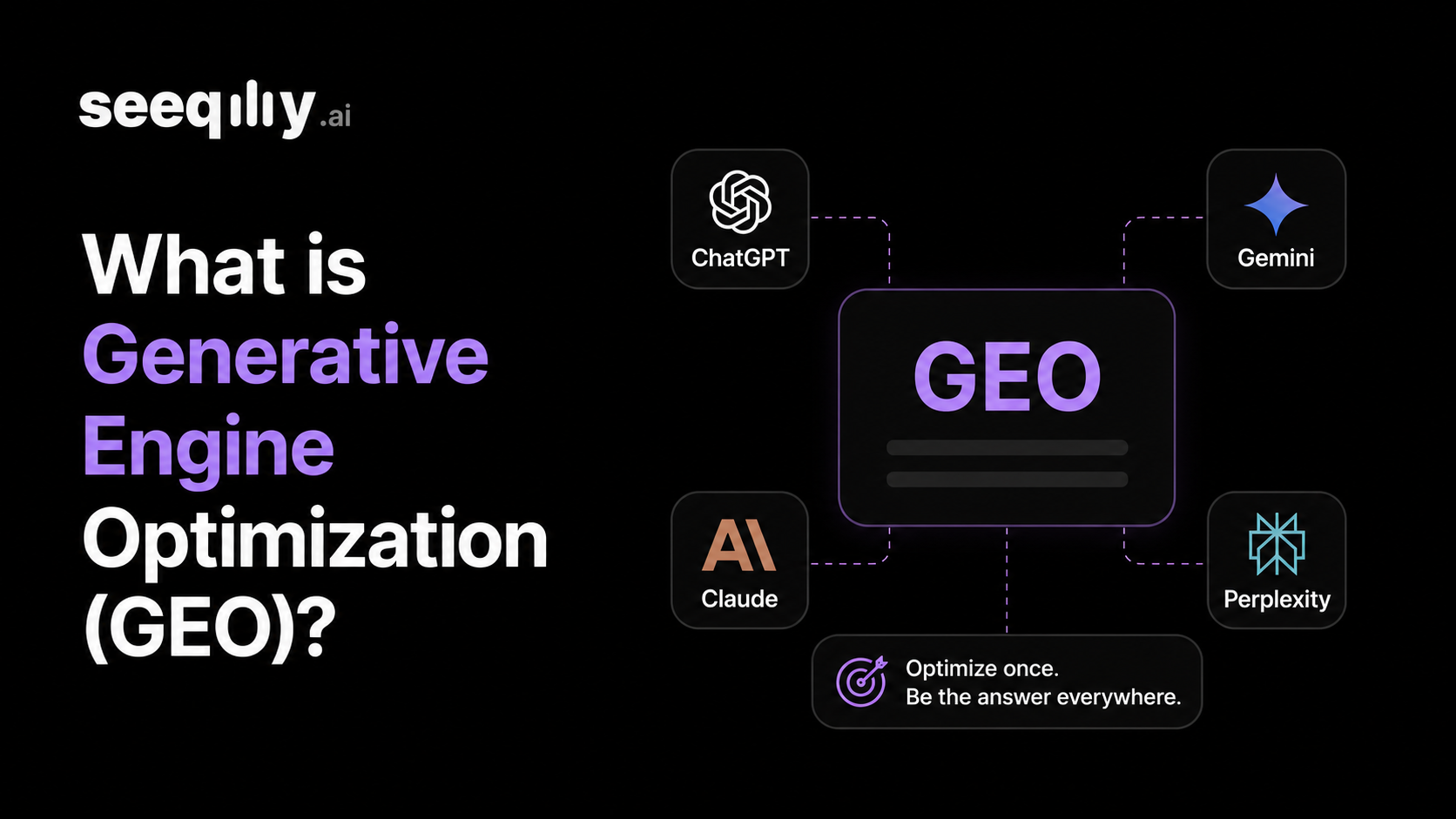
GEO got its name from a 2023 Princeton paper presented at KDD 2024, then ran into the same name that marketing teams had already started using: AEO. The two terms point at almost the same job, with a foot of difference. GEO came out of a measurement lab. AEO came out of CMO offices. Both describe the practice of making sure AI engines like ChatGPT, Gemini, Claude, and Perplexity name your brand when buyers ask. If you have heard one term, you can use the other and not be wrong. This post draws the line where it actually matters, walks through the engines GEO targets, and gives the practical playbook a marketing or SEO lead can take into Monday's standup.
Key Takeaways
- GEO entered the literature as "Generative Engine Optimization" in Aggarwal et al., arXiv:2311.09735. AEO ("Answer Engine Optimization") is the same job under the marketing-team name.
- The target surface in 2026 is ChatGPT, Gemini, Claude, Perplexity, Google AI Overviews, and Microsoft Copilot. Six engines, weighted differently, optimized together.
- 76% of top AI citations come from content updated within 30 days (Omnibound, 2026). GEO rewards recency more aggressively than SEO ever did.
- The playbook reads in 5 steps: source-pool audit, citation density, schema and entity clarity, off-site presence, and recency cadence.
What is generative engine optimization?
GEO is the practice of optimizing a brand's content, schema, and off-site presence so that generative engines name it accurately when users ask a question that maps to the brand's category. The literature definition comes from Aggarwal et al. at Princeton: optimizing content for visibility in generative engine responses (arXiv:2311.09735). That description is intentionally engine-neutral, which is useful because the surface keeps shifting. ChatGPT in 2023 was a different surface than ChatGPT in 2026, and the surface in 2027 will be different again. The job is the same: get cited.
GEO is not "SEO for LLMs," even though that framing keeps coming up. SEO assumes the user will see ten ranked links and pick one. GEO assumes the engine will read forty sources and write one paragraph. The user never sees the source list, only the paragraph. So the unit of optimization changes. You stop optimizing a page that hopes to rank, and you start optimizing a passage that hopes to be lifted intact into the engine's answer.
The other word people use is AEO ("Answer Engine Optimization"). AEO is what most marketing teams say. GEO is what researchers and a slice of the SEO community say. In execution, the two are the same job. In framing, GEO emphasizes the engine (which model wrote the answer), AEO emphasizes the user-facing artifact (which answer the user got). If you are choosing one term for your team, pick the one your stakeholders will recognize. Both are correct.
[INTERNAL-LINK: Compare with the broader AEO mechanic in our 2026 AEO pillar guide]
Is GEO different from AEO?
The short answer: in execution, no. In emphasis, slightly.
Both practices target the same surface. Both reward the same signal stack: clean source-pool composition, schema clarity, citation density, off-site mentions, recency. Both measure success the same way: visibility rate across a tracked prompt set, then citation rate, sentiment, and share of voice against named competitors.
The framing splits along origin. GEO came from an academic measurement context. Aggarwal et al. built an evaluation framework and tested optimization tactics against it. The first three tactics they evaluated (citing sources, quoting evidence, adding statistics) all lifted visibility between 10 and 40 percent in their benchmark (arXiv:2311.09735). That gave the term a research-paper credibility and a measurable taxonomy. AEO came out of marketing teams who saw their Google traffic shrink and asked where else their brand shows up. The early AEO articles were practitioner posts, not papers. The two communities have started merging in 2026; vendors that called themselves AEO platforms in early 2025 now use "AEO/GEO" interchangeably.
For internal documentation, write "AEO" first and put "GEO" in parentheses on first mention. That order signals the term is settled-enough in practice to lead with, and the parenthetical satisfies the audience that knows the research provenance.
Which engines does GEO target?
Six engines, end of 2026, in rough order of US consumer reach.
ChatGPT (OpenAI). The single biggest surface. Pulls from Bing's index plus its own retrieval. Weighted strongly on Reddit and Wikipedia. Recency behavior improved noticeably after the late-2025 browsing upgrade.
Gemini (Google). Tied tightly to Google's index. AI Overviews are a subset of Gemini surfaced inside Google Search itself. Weighted strongly on Google's own knowledge graph entities.
Claude (Anthropic). Smaller surface, fast-growing in enterprise. Retrieval is tool-call-driven; cites sources explicitly with link-outs.
Perplexity. Citation-first by design. Smaller user base but disproportionately strong on technical and B2B queries because the answer paragraph is built around quoted sources.
Google AI Overviews. The summarization layer on top of Google Search itself. Different surface from the Gemini chat product. Same underlying model with different retrieval and ranking on top.
Microsoft Copilot. Built on OpenAI plus Bing's index. Less consumer share than ChatGPT but bundled into Microsoft 365 and Windows, which makes it the default AI surface for a large enterprise user base.
These six engines do not weight sources identically. ChatGPT gives more weight to Reddit threads and Wikipedia than Gemini does. Gemini gives more weight to Google's own structured data than the others. Perplexity rewards content that explicitly answers a query in the first 200 words, because its citation engine pulls direct quotes. A passage that works on one engine often works on all of them, but the optimization is multi-engine, not single-engine.

How is GEO measured?
The visible metric is the visibility rate, the percentage of tracked prompts where your brand shows up at all. A brand at 12% visibility shows up in 12 of every 100 monitored prompts; a brand at 60% shows up in 60. SEO's analog is the keyword rank, which became less useful as Google's SERP fragmented. Visibility rate is more honest because it captures the binary the buyer experiences: did the engine mention me or not.
The richer measurement layer adds three more things on top of visibility.
Citation rate is the percentage of mentions that include a direct link back to the brand's own site. ChatGPT and Perplexity cite differently. A brand can have 60% visibility but 5% citation rate (mentioned, never linked), which means buyers learn about the brand from the engine but never reach the brand's site.
Sentiment is whether the engine described the brand favorably, neutrally, or critically. AI engines describe brands in sentences, not stars. A brand can be cited often and described badly. Sentiment monitoring catches that early.
Share of voice is the brand's visibility against named competitors in the same category prompts. A 40% visibility looks fine standalone but reads as a problem if three competitors are at 60%, 55%, and 50%.
In a healthy GEO program, all four metrics move together. A visibility-only dashboard often hides the issues that matter most.
[INTERNAL-LINK: For the metric stack contrasted with SEO, see our AEO vs SEO comparison]
What does a GEO playbook look like?
Five steps, in the order most teams will execute them. Each step takes between half a day and two weeks depending on team size and starting state.
Source-pool audit. Pull the engines' citation lists for your category's top 30 prompts. Note which sources the engines actually cite. Reddit threads, Wikipedia, YouTube transcripts, vertical review platforms, niche forums, and news outlets dominate; brand blogs usually come in third or fourth. Until you know your category's source pool, you cannot influence it.
Citation density. Once you know the sources, count where your brand is mentioned and where it is missing. A brand mentioned in 4 of 10 relevant Reddit threads has higher citation density than one mentioned in 1 of 10. Density compounds because engines cross-reference.
Schema and entity clarity. Add or repair JSON-LD schema on the highest-traffic pages: Article schema with a named author, FAQ schema where the page answers a recurring question, HowTo schema where the page documents a process, and Organization schema with consistent name, logo, and sameAs entries. Schema does not pick the brand. It labels the brand so the engine knows what kind of thing it is.
Off-site presence. Where your brand is missing from the source pool, build the missing entries. A Wikipedia stub on the company. A founder profile on a category review site. A short, sourced answer on the top-cited Reddit thread for your category. None of this is link-building in the SEO sense; it is presence-building in the AEO sense.
Recency cadence. Update the highest-traffic existing pages on a 30-day rhythm, with date stamps in the visible meta. 76% of top AI citations in 2026 came from content updated within 30 days (Omnibound, 2026). A static evergreen page that ranked for five years can lose its citation slot in one cycle.
The playbook is sequential but not strictly. A team with strong existing schema can skip step 3 and concentrate on steps 4 and 5. A team with a thin content library should pause on step 1 and build the canon before optimizing for the engines that will read it.
When does GEO stop being a separate practice?
The current category split (SEO vs AEO vs GEO) probably has a 3 to 5 year shelf life. Two forces will collapse it.
Schema and structured passage extraction will become first-class Google ranking factors. Right now they help, but the ranking algorithm is dominated by classic signals (links, dwell time, query click data). When Google's quality team formally folds passage extraction into the ranking algorithm, the work that GEO calls "schema and entity clarity" will become baseline SEO. Bing's index has signaled it is heading there sooner than Google.
The metric stack will unify. Today, an SEO team reports rankings to leadership; an AEO team reports visibility rate. Two separate dashboards, two separate vocabularies. The unified dashboard will report a single number called "visibility" that aggregates page rank, AI citation rate, and direct-answer presence into one weighted score. Vendors are already building toward this; one platform reframed in early 2026 to lead with visibility instead of rank.
The category collapse will be uneven. Brands that already do GEO well will see the SEO/AEO/GEO terminology fade into a single visibility practice. Brands that ignored GEO and stayed in pure SEO will spend the next two years scrambling. The half-decade from 2026 to 2031 is the window where treating GEO as a separate, named discipline pays off the most.
What this means for a marketing leader reading this in 2026: do not bet on the category split lasting. Bet on building the underlying signal stack (schema, source pool, recency, off-site presence) that will matter regardless of what the practice is called. The teams that finish 2026 with a working visibility dashboard, three months of source-pool data, and a 30-day recency cadence are the teams that will already be doing whatever the unified practice gets renamed to.