AEO vs SEO: What Changes When AI Writes the Answer
AI Overviews cut position-1 organic CTR by 61% in 2025. AEO and SEO overlap on 60% of the work, diverge sharply on the rest. Here's the practical map.
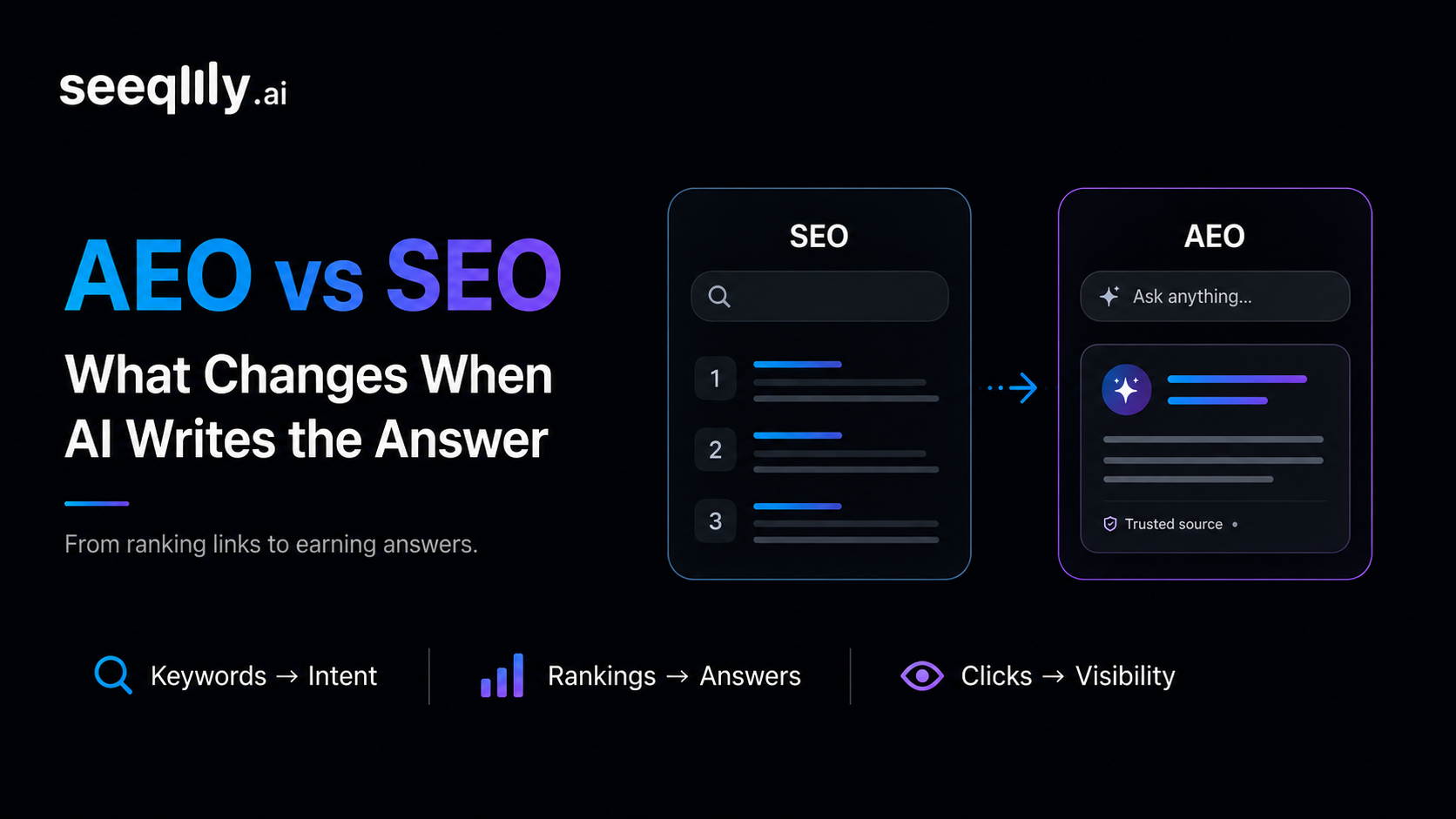
If you've been running an SEO program for the last decade, the muscle memory is page-one rankings, organic traffic, and a Google Search Console dashboard. In 2026, that muscle memory is right about 60% of the time and badly wrong about the other 40%. Seer Interactive's 2025 study of 3.1 million queries put numbers on the gap: organic CTR for informational queries with an AI Overview fell 61%, from 1.76% to 0.61% (Seer Interactive, AIO Impact on Google CTR, September 2025). You're still on page one. You're just below an answer that already satisfied the searcher. So what actually changes, what carries over, and where should your time go?
Key Takeaways
- Position-1 organic CTR dropped 58% (Ahrefs, Dec 2025) to 61% (Seer, Sept 2025) when an AI Overview is present (Ahrefs, Seer).
- 42% of B2B content marketers have reallocated budget from SEO content to AEO content (SEJ State of AEO/GEO 2026).
- The two practices share ~60% of the underlying work (schema, hygiene, editorial quality). The other 40%, off-site presence and recency, is where AEO diverges.
How is AEO different from SEO at the mechanic level?
SEO targets a ranking. AEO targets a citation. That's the one-line version, and it's accurate, but the deeper mechanic is this: SEO ships pages, AEO ships passages.
Google's job, simplified, was to rank ten pages and let the user pick. An AI engine's job is to write one paragraph and pick for them. Pages won. Now passages win. 76% of top AI citations in 2026 came from content updated within 30 days (Omnibound GEO Statistics, 2026), which means a stale evergreen post that ranked for five years can lose its citation in a single re-indexing cycle.
The source pool changes too. SEO drew on a clear universe: domains that ranked. AEO draws on Reddit comments, YouTube transcripts, Wikipedia, podcast notes, niche forums, and review platforms, often weighted heavier than your own site. 68% of AI citations originate off-site (Omnibound, 2026). For the full pillar context on AEO mechanics, see our 2026 AEO guide (coming soon).
Where do the two practices overlap?
Roughly 60% of the underlying work is shared. Technical hygiene matters the same way it always did. Crawlability, structured data, page speed, clean URLs, sensible internal linking, no broken canonicals. AI engines crawl through the same pipes Google did; if your site can't be indexed, it can't be cited.
Editorial quality also carries over. Strong original writing with named sources is better SEO and better AEO. The difference is shape. SEO optimized for a comprehensive page that ranked across a keyword cluster. AEO optimizes for a tight paragraph that can be lifted intact. A 2,000-word guide that buries the answer in section five will still rank, maybe, but it won't be cited.
Schema markup is the cleanest example of double-duty work. FAQ schema, HowTo schema, and Article schema with named authors help on both surfaces. Adding them is the highest-leverage hour you'll spend on a page that already ranks. Schema doesn't write the answer; it labels it so the engine knows what kind of thing it is.
E-E-A-T (experience, expertise, authority, trust) signals from named authors and credentialed contributors also transfer cleanly. AI engines weight named human authors slightly higher than generic "Team" bylines, mirroring Google's stance.
What metrics replace rankings in AEO?
The ranking number, your position from 1 to 10, becomes the visibility rate, your percent of tracked prompts where you're mentioned at all. Position survives, but in a smaller range, often 1 to 3 inside the answer rather than 1 to 100 inside results. Click-through rate matters less because clicks themselves are scarcer; many AI answers settle the question without a click.
Three new metrics anchor AEO measurement. Visibility rate (do you show up?). Recommendation rate (did the engine actually recommend you, or just list you in passing?). Citation depth (how many external sources backed the answer, and which ones?). The recommendation rate is the single most actionable, because being mentioned without recommendation is the AEO equivalent of ranking on page two; technically you exist, practically you don't convert.
| Old SEO metric | AEO counterpart | What it tells you |
|---|---|---|
| Ranking position | Visibility rate + position distribution | Are we in the answer at all, and where? |
| Organic CTR | Recommendation rate | When mentioned, do we get recommended? |
| Domain authority | Engine concordance | Do engines agree about us across platforms? |
| Backlink count | Citation depth | How many off-site sources back our presence? |
| Featured snippet | First-mention rate | Are we the first brand named in the answer? |
Share of voice is the metric most teams already understand. Apply it inside AI answers and you get a fast read on category leadership. For how to compute it correctly, see share of voice definition (coming soon).
How should your team and budget actually shift?
The single biggest reallocation is from on-site to off-site. Industry data shows 42% of B2B content marketers have already moved budget from SEO content to AEO content (SEJ, 2026). Most of that money should flow to Reddit and YouTube. Reddit alone, at its 2025 peak, accounted for 47% of Perplexity's top citation sources. YouTube currently shows the strongest single-source correlation with AI citation, at 0.737 (Omnibound, 2026).
Review platforms are the second cluster. G2, Capterra, and TrustRadius profiles show a 2.6x to 3.5x AEO citation multiplier for B2B brands. A consumer brand should treat category-specific review surfaces (Mouthshut in India, Google reviews, Trustpilot) with the same weight.
From the field: We've seen brands re-allocate 40% of a $20k monthly SEO budget into off-site work and double their AI citation count in a single quarter, without losing a single Google ranking. The signals are additive, not competitive.
Team composition shifts slightly. You still need SEO operators for the shared 60% of the work. You also need an off-site lead, often someone who looks more like a community manager or PR generalist than a traditional SEO. Content writers stay, but the brief changes from "comprehensive guide that ranks" to "paragraphs that can be cited".
When does each practice still win?
SEO still wins where the buyer wants a comparison, a deep dive, or a hands-on tutorial they'll work through. Long-tail informational queries where the user genuinely wants a webpage, not a one-paragraph answer, still favor classical pages. Software documentation, code tutorials, data dashboards. Anything where the user is doing the work, not asking about the work.
AEO wins everywhere a buyer asks a question whose answer is itself the purchase decision. "Best CRM for a 20-person team in Bengaluru". "Which analytics tool integrates with both Mixpanel and Snowflake". "What's the best home insurance provider in India for renters". These are the high-intent prompts that pass through an AI answer, often without a single click downstream. If you're not in the answer, you're not in the shortlist. For the engine-by-engine tactical version, see our engine playbooks pillar (coming soon).
Frequently asked questions
Does AEO replace SEO?
No. AEO rebalances SEO budget rather than replacing it. About 60% of the underlying work (schema, hygiene, editorial quality, crawlability) is shared. The 40% that diverges, off-site presence and recency, is where new investment goes (SEJ State of AEO/GEO, 2026).
How long before I see AEO results?
Most brands see initial citation movement within two to six weeks of sustained off-site work, faster if existing SEO equity is strong. ChatGPT, in particular, weights freshness aggressively, so 30-day update cycles compound visibly within a quarter (HubSpot AEO Trends 2026).
Can I keep my SEO content as-is and just add AEO on top?
You can keep the page but you'll want to add structure. Front-load the answer in the first 60 words. Add FAQ schema. Add named authors. Update the lastUpdated field. Doing this on the top 20 existing pages is the fastest AEO win available to teams with mature SEO.
What's the cheapest way to start AEO?
Start with measurement and one off-site channel. Pick your top five prompts, run them weekly across two AI engines, and track who shows up. At the same time, commit to one Reddit answer per week in a relevant sub. That's a $0 program, and it generates more signal than a $3,000-per-month tool with no off-site effort.
What to do this week
If you've made it this far, two practical moves. First, audit your top 10 existing SEO pages with the AEO lens: is the answer in the first 60 words, is FAQ schema present, is there a named author, was the page updated in the last 90 days? Each "no" is a quick fix. Second, pick the single off-site surface where your category buyers live (Reddit, YouTube, G2, Mouthshut, Quora) and commit to a weekly cadence.
For ongoing measurement, Seeqly tracks your brand inside ChatGPT, Gemini, Claude, and Perplexity daily. If you want to see your AEO baseline before deciding the budget shift, the trial is 7 days, no card.
Sources
- Ahrefs, AI Overviews Reduce Clicks Update, December 2025. Retrieved 2026-05-20. https://ahrefs.com/blog/ai-overviews-reduce-clicks-update/
- Seer Interactive, AIO Impact on Google CTR, September 2025 Update. Retrieved 2026-05-20. https://www.seerinteractive.com/insights/aio-impact-on-google-ctr-september-2025-update
- Omnibound, Generative Engine Optimization Statistics, 2026. Retrieved 2026-05-20. https://www.omnibound.ai/blog/generative-engine-optimization-statistics
- Search Engine Journal, The State of AEO/GEO 2026: CMO Investment Report. Retrieved 2026-05-20. https://www.searchenginejournal.com/partner-resources/state-of-aeo-geo-in-cmo-investment-report/
- HubSpot, Answer Engine Optimization Trends 2026. Retrieved 2026-05-20. https://blog.hubspot.com/marketing/answer-engine-optimization-trends
- CMSWire, Reddit's Rise in AI Citations. Retrieved 2026-05-20. https://www.cmswire.com/digital-marketing/reddits-rise-in-ai-citations-what-marketers-must-know-about-aeo-strategy/