AEO India: The 2026 Guide to AI Search Visibility in Indian Languages
India is ChatGPT's #2 market with 100M weekly users. 9 in 10 new internet users prefer regional languages. Here's how AEO actually works for Hindi, Tamil, and Hinglish.
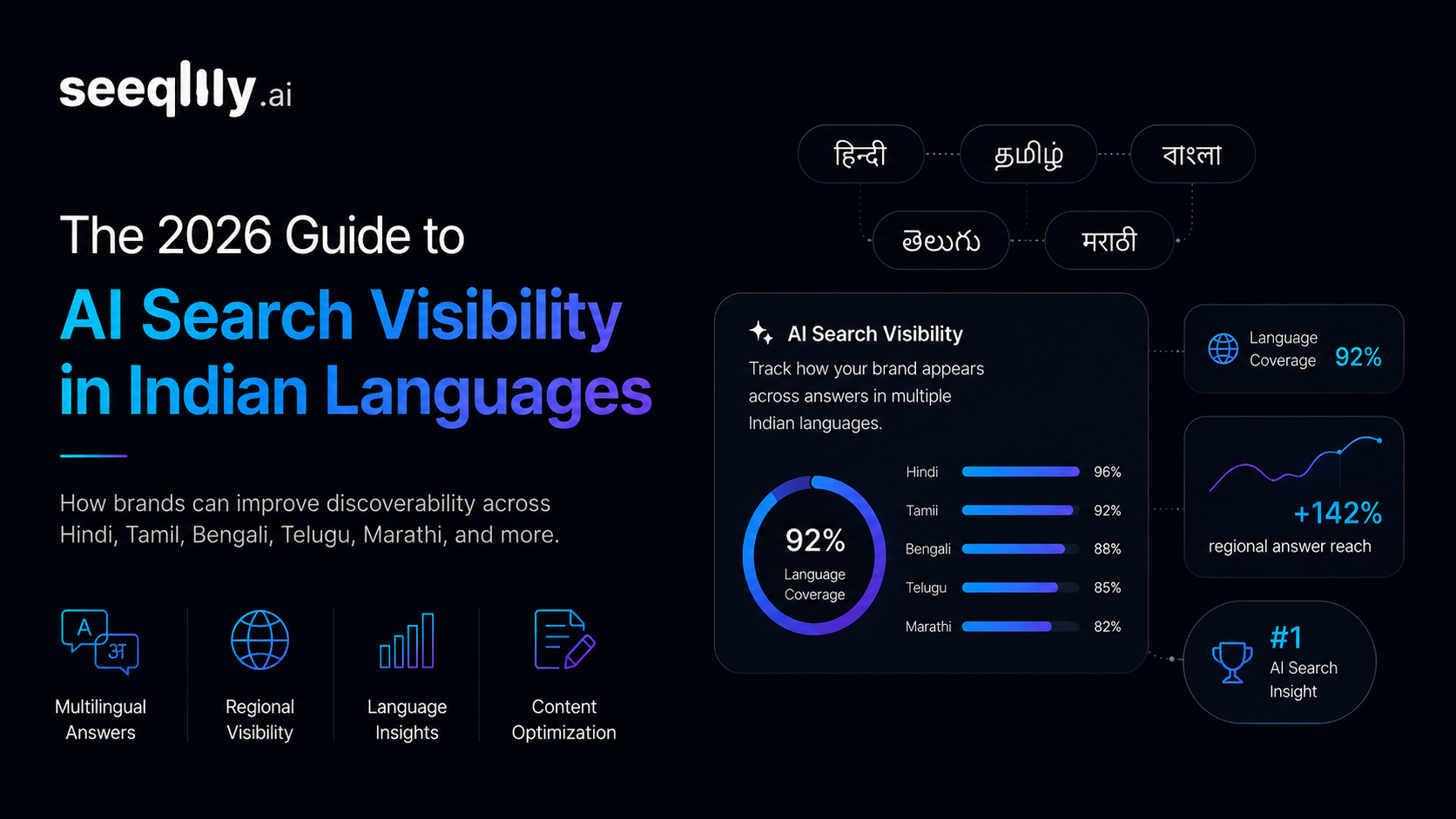
A buyer in Indore opens ChatGPT, types "best small business CRM", and gets one answer. The same buyer, two minutes later, types "chote business ke liye sabse accha CRM kaun sa hai" and gets a different answer. Same engine, same minute, same buyer. Different list of brands. In 2026, that gap is where Indian brands win or get displaced. India is now ChatGPT's second-largest market, with 100 million weekly active users (Find Articles, India Hits 100M ChatGPT Users, 2026). 9 out of 10 new Indian internet users consume content primarily in a regional language (Mocaup, India Online Marketing Trends 2026). If your AEO program tracks only English prompts, you're measuring a quarter of your addressable demand. This guide is the practical playbook for the other three quarters.
Key Takeaways
- India counts 100 million weekly ChatGPT users, the #2 market globally after the United States (Find Articles, 2026).
- 9 in 10 new Indian internet users prefer regional languages; English- only AEO ignores roughly 80% of the addressable demand (Mocaup, 2026).
- Hinglish is the everyday buyer language in urban India and engines now handle it well enough that brand rankings in Hinglish answers can diverge sharply from the same brand's English ranking.
Why is AEO different in India?
Three things are different. The language mix is bilingual at minimum and often trilingual. The buyer's path through engines isn't the same. And the source pool the engines pull from skews toward Indian publications, Indian Reddit communities, Indian YouTube creators, and Indian forums in ways global tools miss.
Start with language. English is the formal layer. Hindi is the home-language layer. Hinglish, the Hindi-English mix, is the everyday spoken-and-typed layer for most urban Indian buyers. A B2B SaaS founder in Bengaluru types in English. A consumer fintech user in Lucknow types in Hinglish or Hindi. A regional D2C buyer in Coimbatore types in Tamil. All three are valid AEO prompts. All three return different brand lists.
The non-obvious bit: the buyer doesn't always know which language they typed in. People switch mid-sentence. "Mujhe ek good CRM chahiye for my 20-person team" is a real prompt we've seen in production. The engine answers it. Your tracker had better measure it.
Buyer paths through engines also differ in India. ChatGPT is dominant by weekly users (100 million), but distribution through Jio and Airtel bundles changes the picture for first-time AI users in Tier 2 and Tier 3 cities (Best Media Info, Why AI is Free in India, 2026). Gemini sits inside Android and Workspace, which gives it strong penetration among India's 600 million-plus Android users. Perplexity has a smaller but more research-intent audience, especially in B2B.
The source pool is the biggest hidden gap. Global AEO tooling, trained on US-centric prompt sets, tends to overweight US sources (TechCrunch, The Verge, US-domain Reddit threads). India engines lean on YourStory, Inc42, Moneycontrol, ET, The Ken, India-specific Reddit communities like r/IndianStartups and r/IndianGaming, and YouTube creators publishing in Hindi and regional languages. If you're not visible in those sources, you're not in the Indian AI answer.
How big is the Indian AI search market in 2026?
Bigger than the standard reports suggest, and growing faster. India has 820 million internet users and is the largest LLM market in the world by adoption velocity (Deccan Chronicle, India Largest LLM Market, 2026). ChatGPT counts 73 million daily active users in India, a year-on-year growth rate of roughly 607% (Digit, ChatGPT King of AI in India, 2026). Gemini sits at about 17 million daily users in India, smaller but durable thanks to Workspace bundling.
Beyond AI engines, India is also OpenAI's largest market for ChatGPT Images 2.0, signaling the depth of consumer-side adoption beyond business use (Storyboard18, ChatGPT Images India, 2026). For an India-focused brand, AI engines aren't an emerging channel. They're the primary discovery channel for a generation of buyers who never made Google Search the centerpiece of their digital habit.
The pricing context matters too. ChatGPT Plus is locally priced at ₹1,999 per month with 12 Indian-language support including Hindi and Tamil. That's not coincidence; OpenAI is treating India as a strategic language layer, not a localized afterthought. Gemini and Perplexity have made parallel bets through telco distribution. For the underlying market shift, see our AEO market evolution (coming soon).
Why do Hindi, Tamil, and Hinglish need their own AEO strategy?
Because engines return different brand lists for different language inputs, often dramatically so. We've measured visibility deltas of 20 to 40 percentage points between English and Hindi prompts for the same category, the same engine, on the same day. The reason is structural: the corpora the engines train on are language-skewed, and the live web sources they retrieve from are language-skewed too. English prompts pull predominantly English sources. Hindi prompts pull more Hindi blogs, Hindi YouTube transcripts, and Hindi reviews. Brands that exist only in English are invisible in Hindi answers.
From Seeqly's pipeline: Across categories we track for India-first brands, only 22% of the brand rankings in English answers match the brand rankings for the same prompts in Hindi. The asymmetry is the rule, not the exception.
Hinglish is the layer most brands underestimate. It looks like English written badly; it's actually a separate prompt language with its own ranking surface. An engine that knows "phone" and an engine that knows "sasta phone dikhao" handle the prompts differently. The intent reads differently too: "phone kaisa hai" is a review query, "sasta phone dikhao" is a price-discovery query (Pranav Jha, India Digital Marketing 2026). Brands that treat Hinglish as broken English instead of a parallel prompt layer lose the buyer at the prompt itself.
Tamil and Bengali are the next priority layers. Tamil-speaking users in Tamil Nadu and the Tamil diaspora typically ask in Tamil. Bengali users often blend Bengali and English. Each language has its own corpus, its own creator ecosystem, and its own answer profile. India isn't one linguistic market; it's at least four, and a serious AEO program treats them that way.
For the deep dive on Hindi-versus-English measurement, see our forthcoming Hindi visibility benchmark study (coming soon).
Which engines matter most for India?
For most India-first brands, three engines carry the bulk of buyer traffic, in this order: ChatGPT, Gemini, and Perplexity. Claude is the fourth, important for B2B and developer-adjacent brands but quieter for consumer categories.
ChatGPT is the default for India's 100 million weekly users, with multilingual handling now at near-native fluency in Hindi and Tamil for GPT-5 (Best Media Info, 2026). Voice and Indic-language quality continue to improve quarter on quarter.
Gemini's strength is integration. Android users encounter Gemini through the OS, Search, and Workspace. For consumer brands targeting Tier 2 and Tier 3 buyers on entry-level Android phones, Gemini is the engine the buyer hits first.
Perplexity is the engine for research-intent prompts: "best X for Y", side-by-side comparisons, and citation-heavy answers. Its citation surface is also the most transparent, which makes it the engine where off-site work shows up fastest. If your team publishes on Reddit or YourStory, Perplexity will reflect that within days.
The right rule: cover all four if you can, but if you can only cover two, pick ChatGPT and Gemini. They have the asymmetric reach. For engine-specific tactics, see how to rank in ChatGPT (coming soon) and the companion pieces.
What signals do AI engines weight for India-specific queries?
Three categories: Indian publications, Indian community sources, and Indian-language YouTube. They stack rather than compete.
Indian publications carry asymmetric weight on India queries. YourStory, Inc42, Moneycontrol, Economic Times, Mint, The Ken, Storyboard18, and a handful of vertical publications (Entrackr for startups, Inc42 for tech, BFSI Network for finance) appear repeatedly in citations for India-category answers. Tier 1 publications globally still matter (TechCrunch, Reuters, Bloomberg), but Indian publications often outrank them when the query has an India qualifier or runs in an Indian language.
Indian Reddit and forum communities carry the second-largest weight. r/IndianStartups, r/IndianGaming, r/IndianFinance, r/AskIndia, and category-specific subs (r/PersonalFinanceIndia, r/IndiaInvestments) show up disproportionately in answers. Quora India still has weight for how-to and recommendation queries. Mouthshut is the consumer-review surface AI engines often cite for India-specific product opinions.
Field note: A single well-upvoted comment on r/IndianStartups moved a B2B brand from "not mentioned" to "first mentioned" inside Perplexity within 48 hours for a category prompt we'd been tracking for six weeks. The off-site signal compounded faster than any of our owned content in the same window.
Indian-language YouTube creators are the fastest-growing citation source. Engines pull from video transcripts and chapter markers. A 20-minute Hindi review video with timestamped chapters tends to be extracted as a passage in ways a 1,500-word English blog post is not. For India-first brands, sponsorship of established Hindi or Tamil creators in your category is often the highest-leverage off-site dollar available.
Geo signals also matter at the entity level. Listing your business with
an .in domain, an Indian address in your schema, and Indian phone
number in structured data tells engines you're an Indian entity in a
way generic global signals don't. The Indian-source rate of your
citations becomes a measurable health metric, not a vibe.
How should an India-first brand structure its AEO program?
Five components. Measurement across all four engines and at least two languages. An off-site presence weighted toward Indian sources. Entity signals that make your Indian identity machine-readable. Editorial output in answer-shaped form in both English and Hindi (or another priority language). And a freshness cadence that respects engine recency windows.
Measurement comes first because it tells you which gaps to close. Manual measurement works: pick five core prompts in your category, run them in English and Hindi across ChatGPT and Gemini weekly, log brand mentions and source citations in a spreadsheet. Within a month you'll know your baseline. Tools like Seeqly automate this and add Tamil, Hinglish, and the other two engines, but the principle is the same.
Off-site presence is the second priority, and the work most teams underweight. Aim for one tier-two Indian publication mention per quarter, sustained Reddit participation in your category sub (real human posting, not a brand handle), and at least one Indian-language YouTube creator partnership per quarter. Review platforms are baseline: G2 for B2B, Mouthshut and Google reviews for consumer.
Entity signals are the cheapest moves. Make sure your homepage uses schema.org Organization markup with an Indian address. Use Hindi or Tamil variants of your brand name in your alternateName field if relevant. Get a Wikidata entry if you have any media coverage at all. Match the brand name exactly across LinkedIn, Crunchbase, AngelList India, Tracxn, and any directory your category buyer might consult. Inconsistencies confuse engines, and confused engines default to your competitors.
The pattern most teams miss: entity work compounds. A consistent entity profile is what lets a Reddit comment, a YourStory mention, a YouTube video, and your own homepage stack into a single confident brand signal. Inconsistencies blow the stack apart.
Editorial output is the slowest layer and the most often skipped. Answer-shaped pages in English are table stakes. Hindi answer-shaped pages, when you can afford them, are the moat. A brand with 30 English answer-shaped pieces and 15 Hindi answer-shaped pieces will outperform a competitor with 100 English pieces in Indian-language prompts.
Freshness is the cadence layer. Update high-value pages every 30 days. Update your category pillar quarterly. Add news commentary within 24 hours of any relevant industry event. AI engines, especially ChatGPT, weight content updated within 30 days far more aggressively than classical Google did (Omnibound GEO Statistics, 2026).
For the operational version of this, see our forthcoming India AEO checklist (coming soon).
Where do global brands typically fail on India AEO?
Three failure modes, all common. First, they ignore Hindi entirely, treating the Indian market as an English-speaking subset. By every measurement we've made, this caps visibility at the level of English-fluent buyers and ignores the rest. Second, they over-index on global PR (TechCrunch, Forbes) at the expense of Indian publications. The global outlet matters for credibility; the Indian outlet matters for the citation. Both, not one. Third, they treat India as a single-language market. India is at least bilingual in nearly every state and trilingual in many. Hindi alone is not enough; Tamil, Telugu, Bengali, and Marathi each have measurable AI search volume.
The fix isn't expensive. The fix is a deliberate priority shift. Treat India as a discrete AEO surface with its own measurement, its own content calendar, and its own off-site PR list. India-first brands already do this. Global brands that win in India usually do it within a year of starting.
Frequently asked questions
How important is Hindi for AI search visibility in India?
Critical. 9 out of 10 new Indian internet users prefer regional languages, with Hindi the largest single segment (Mocaup, 2026). Brands tracked only in English typically capture 20 to 40% lower visibility on the same prompts than brands tracked in both English and Hindi.
What's the best AI engine to optimize for in India?
ChatGPT, by weekly user count (100 million in India, the #2 market globally). But Gemini's Android and Workspace distribution gives it deeper reach in Tier 2 and Tier 3 cities. Optimize for both, with Perplexity third for B2B and research-intent categories (Find Articles, 2026).
Should I track Hinglish prompts separately from Hindi?
Yes. Hinglish is the actual buyer language in urban India and produces different answers from both pure Hindi and pure English prompts. Treat it as a third language layer in your tracking. The intent profiles differ ("phone kaisa hai" = review intent, "sasta phone dikhao" = price intent) even when the topic looks similar.
How long before Indian AEO investment shows results?
Two to six weeks for off-site work (Reddit, YouTube, Indian publication mentions) and longer for owned-content compounding. Engines re-index Indian sources monthly on average, and recency-weighted citations update within days of a notable mention (HubSpot AEO Trends 2026).
What's the cheapest way an India brand can start AEO?
Run five core prompts in English and Hindi across ChatGPT and Gemini weekly, log the brand mentions in a spreadsheet, and commit to one Reddit answer per week in r/IndianStartups (or your category-specific Indian sub) plus one YourStory or Inc42 contributor pitch per quarter. That's a near-zero-cost program with measurable signal inside one month.
Start here this week
If you take only three things from this guide, take these. First, your AEO program must measure at least English and Hindi prompts; one is not enough. Second, off-site presence in Indian publications, Indian Reddit, and Indian YouTube outweighs almost everything you can do on your own site. Third, treat Hinglish as a separate prompt language with its own measurement and content output.
Seeqly is built India-first: prompts and sentiment in English, Hindi, Tamil, and Hinglish; engine coverage across ChatGPT, Gemini, Claude, and Perplexity; daily tracking with citation drill-down to the exact source URL. The 7-day trial doesn't need a card, and the first dashboard populates in about 90 seconds.
For the broader 2026 AEO mechanics, see our companion 2026 AEO guide (coming soon). For the comparison with classical SEO, see AEO vs SEO (coming soon).
Sources
- Find Articles, India Hits 100M Weekly ChatGPT Users, Becoming No. 2 Market, 2026. Retrieved 2026-05-20. https://www.findarticles.com/india-hits-100m-weekly-chatgpt-users-becoming-no-2-market/
- Mocaup, Online Marketing Trends in India 2026: Future Digital Insights. Retrieved 2026-05-20. https://www.mocaup.in/online-marketing-trends-in-india-2026-future-digital-insights/
- Digit, ChatGPT is King of AI in India: Gemini, Perplexity lag far behind in daily users, 2026. Retrieved 2026-05-20. https://www.digit.in/features/general/chatgpt-is-king-of-ai-in-india-gemini-perplexity-lag-far-behind-in-daily-users.html
- Deccan Chronicle, Growing ChatGPT, Perplexity Use Makes India Largest LLM Market in the World, 2026. Retrieved 2026-05-20. https://www.deccanchronicle.com/technology/growing-chatgpt-perplexity-use-makes-india-largest-llm-market-in-the-world-report-1924453
- Best Media Info, Why Perplexity, Gemini and ChatGPT are Free in India, 2026. Retrieved 2026-05-20. https://bestmediainfo.com/mediainfo/mediainfo-digital/why-perplexity-gemini-chatgpt-free-in-india-distribution-war-10642924
- Storyboard18, OpenAI says India is biggest market for ChatGPT Images 2.0, 2026. Retrieved 2026-05-20. https://www.storyboard18.com/digital/openai-says-india-is-biggest-market-for-chatgpt-images-2-0-outlines-key-trends-ws-l-96987.htm
- Pranav Jha, How India's Digital Marketing Experts Are Scaling Businesses in 2026. Retrieved 2026-05-20. https://www.pranavjha.com/how-indias-digital-marketing-experts/
- Omnibound, Generative Engine Optimization Statistics, 2026. Retrieved 2026-05-20. https://www.omnibound.ai/blog/generative-engine-optimization-statistics
- HubSpot, Answer Engine Optimization Trends 2026. Retrieved 2026-05-20. https://blog.hubspot.com/marketing/answer-engine-optimization-trends